There's a lot of talk these days about wellbeing, psycho social hazards, burnout and stress. It's great that we're talking more openly about these things; the last few years have been a wild ride for most. From COVID to interest rates, it's felt like a never ending onslaught.
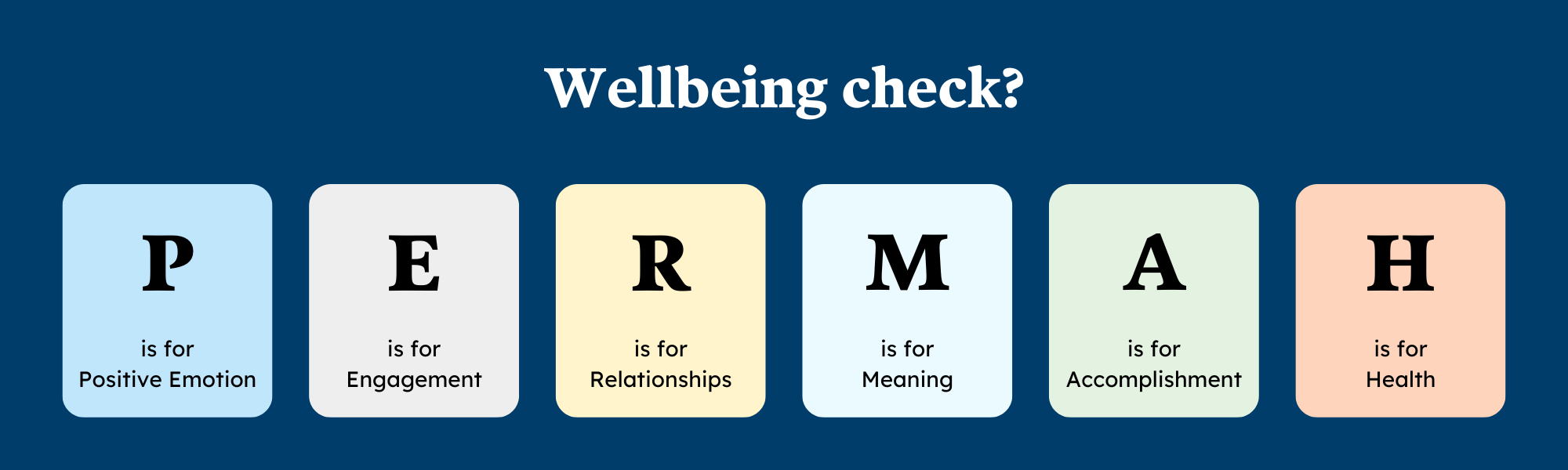
So, if you're thinking about your own wellbeing, or about the wellbeing of your colleagues, it's helpful to have a framework for what to check in on. Luckily for us, the field of positive psychology has been looking deeply into what makes people thrive for 25 years now. There are a number of useful tools & theories (links below), but one of the most well-researched and holistic frameworks is the PERMA+ model.
The original PERMA model (2011) included five key elements: positive emotion, engagement, relationships, meaning & accomplishment. Since then, others have added to the model (creating PERMA+), most notably by adding measures of (physical) health like sleep, exercise and nutrition.
There are two key reasons why I believe this is the most useful model for checking in on wellbeing, especially individual wellbeing:
The first is that it has been shown to correlate very strongly (r = .98) with our best measures of subjective wellbeing - people's overall assessment of how satisfied they are with their lives now and over the long term. That indicates that there's good reason to believe that the PERMA framework captures at least most of what matters, and measures it well enough to be useful.
The second is that by breaking wellbeing down into its key components, we are able to get a strong signal for where problems lie, or where potential gains are likely to be able to make a difference. For me, this is the most important reason. I am not a researcher, I'm a practitioner. When I'm measuring wellbeing it's because I want to be able to make it better.
So, with that said, how do you use this model to check-in on wellbeing, and use that information to make changes?
Take the PERMAH Profiler for free. This will give you your results on each of the dimensions and allow you to compare your scores to others based on age, income and education level.
Using your results, identify your key areas of strength (your top 3), and areas where you could make changes (bottom 3).
For each area of strength, identify one or two things that you are already doing that you think contribute to this area being a strength for you. These are things that you want to make sure you protect and maintain as you make changes.
For each area of opportunity, identify one small, easy change you could make that might help you develop a new useful habit. Keeping the changes small and easy will help you to create momentum, then as the new habits form you can build on them.
If you're wanting to check in on wellbeing with others, or on a larger group, then you can use the PERMAH framework to open a discussion - being mindful that you're not requiring people to share their personal experiences and feelings with you. Wellbeing is a deeply personal topic, and your interest in their wellbeing does not trump their right to privacy.
The use of personal wellbeing frameworks and training in workplaces is nuanced and complex. Every person's wellbeing will be impacted by factors both inside and outside of the workplace. Done well, measurement of wellbeing can help you identify areas where work can be helpful, or is currently being harmful so that you can make targeted changes. But done badly, any wellbeing assessment can result in people feeling like the workplace is blaming them for feeling bad, and requiring them to fix their own wellbeing for the benefit of the employer. That's not ok.
If you're interested in measuring wellbeing in your workplace, and you want to avoid doing it badly, book in a chat with me (free). If I can help you with advice in under 30mins, I will. And if you need more help than that, we can talk about what that would look like and whether it's in your budget.
And if you're looking for some support to make individual changes that will help you thrive, consider coaching. Like a personal trainer for wellbeing, we can help you to figure out what changes might help, and then support you to implement them. Drop us a line if you'd like to learn more about wellbeing coaching.
Research & resources
Fallon R. Goodman, David J. Disabato, Todd B. Kashdan & Scott Barry Kauffman (2018) Measuring well-being: A comparison of subjective well-being and PERMA, The Journal of Positive Psychology, 13:4, 321-332, DOI: 10.1080/17439760.2017.1388434